Giving Birth to What You Already Know: A Philosophical Counseling Perspective
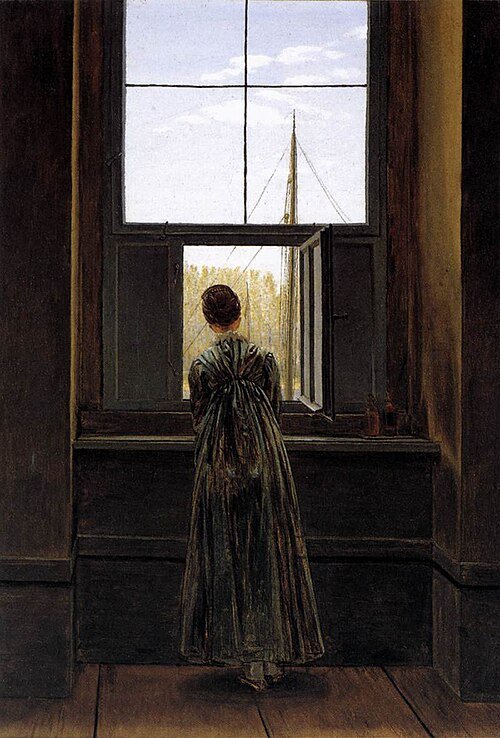
Caspar David Friedrich - Woman at a Window
There is something you know that you don't know you know.
It's not hidden exactly. It's more like it hasn't found its form yet. You sense it when you're lying awake at three in the morning, or when a conversation brushes up against something tender and you quickly steer away. You've circled it in journals. Maybe mentioned it obliquely to a friend, or a therapist, and watched their response land somewhere close but not quite there. And then you move on, because life keeps moving, and you tell yourself you'll come back to it.
But you don't come back to it. Or you do, and you're still circling around it, seeing the edges but not the middle.
What is it like to hold something like that for years? Something that feels important, maybe even urgent, and yet keeps sliding out of reach the moment you try to look directly at it? Perhaps you've tried therapy, or coaching, and found that neither quite reached the thing you were trying to name. If so, you're not alone, and this kind of inner inquiry may be pointing toward something different.
I've been sitting with this question for a long time, both in my own life and in the work I do with others. And what I've come to suspect, slowly and with some surprise, is that the problem isn't that we lack insight. It's that insight, in its unformed state, is not yet something we can hold. There's clay but not a pot. It needs certain conditions to take shape. And one of those conditions is another person.
This is not an obvious thing to accept. We are, most of us, deeply committed to the idea that we know our own minds. That our thoughts belong to us, are available to us, and that the project of self-understanding is essentially a solitary one. We may invite others in for support, or perspective, or comfort. But the knowing itself — we assume — is ours to do alone.
What if that assumption is the very thing in the way?
Consider for a moment what actually happens when you speak. Not the words themselves, but the act. When you begin to put something into language, you are not retrieving a finished thought from some internal filing cabinet and simply reporting it. You are, in many cases, discovering what you think in the process of speaking it. The words arrive, and then you hear them, and sometimes you stop mid-sentence and say — "wait, no, that's not quite it" — and try again. And in trying again, something shifts. Something sharpens.
Now consider what happens when someone is truly present with you while you do this. Not planning their response. Not waiting for you to finish so they can offer their own experience in return. Not analyzing you or steering you toward a conclusion they've already reached on your behalf. Just... attending. With genuine curiosity. Following the thread of what you're saying as it appears, noting what seems alive, asking the question that emerges from the moment itself rather than from an agenda.
What happens then is something different. Something of a different order, though it can be hard to say exactly why until you've felt it.
The ancient Greeks had a word for it, and a practice built around it. Maieutics. The word comes from the Greek for midwifery, and it was Socrates who first used it to describe what he did in conversation. He said he was like his mother, who was a midwife. She didn't create the life she helped bring into the world. She was present for a process that was already happening, with the skill and attention to help it complete itself.
Socrates thought the same was true of ideas. That the insights we carry, the understanding we seek, the knowing that is somehow already in us but hasn't arrived yet into full form — all of this can be helped into being by the right kind of presence. The guide doesn't give you the answer. The guide helps you give birth to the one already forming.
This is the heart of what philosophical counseling offers. Not diagnosis, not a treatment plan, not a program of goals to achieve. Something older and, in some ways, more demanding: sustained dialogue that helps you see what you already know.
I find this image both humbling and exact. It asks something of the guide: that they get out of the way of their own cleverness, their own need to be useful, their own desire to solve. And it asks something of the person doing the inquiring too — a willingness to not know, to stay with the uncomfortable not-yet-formed feeling rather than grabbing for the first answer that appears, which is usually an old one, a borrowed one, a well-worn response that keeps the real questions, the real ideas, at bay.
So perhaps what we are really talking about is a particular quality of listening. Not passive listening — that's a misunderstanding. What I mean is something more like active witnessing. A presence that doesn't collapse the space around what's being said, but holds it open. That can sit with the incomplete thought, the half-formed feeling, the "I don't know how to say this" and wait there, without flinching toward resolution.
Most of us have rarely experienced this. We're used to conversations that move toward conclusions. Toward advice, or comfort, or practical next steps. These are not bad things. But they are different from what happens in genuine philosophical dialogue, where the goal is not to arrive anywhere in particular, but to see more clearly what is actually here.
When someone listens to you that way, something unusual can happen. You begin to hear yourself differently. The words you've been using — the story you've been telling about your situation, your feelings, your life — start to show their edges. You notice where the story is solid and where it's borrowed. Where it came from you and where it came from somewhere else: a parent's voice, a culture's expectation, an experience as a young person, a fear that got dressed up as a value somewhere along the way.
This is not analysis. It isn't therapy. And it isn't coaching. It's the deepest form of self discovery. It's more like the mirror that shows you what you couldn't see when you were looking on your own — because it is clear, and still, and facing you directly, held in a light that helps you see the jewel of your self shine as the light reflects in each facet.
What gets lost when we never have this?
Not everything. Life keeps going. We adapt. We make decisions, form opinions, pursue directions. But a low-grade confusion can settle in over time. The life we're living starts to feel assembled from parts that don't quite cohere, a story we're telling that hasn't been examined so much as inherited. Beliefs held with real conviction that we never once actually chose. We confuse all of this for wisdom, and our genuine questions, for weaknesses to be overcome.
This is where examining assumptions becomes not a philosophical exercise but a practical necessity. There is a difference between a thought that is yours and a thought you were handed. Between a value you would affirm on reflection and one you were simply never given occasion to question. Most people carry both, and they mix together invisibly. We can't always feel the difference from the inside. Not without a mirror.
And perhaps this is the cost of moving through life always in motion, always solving, always filling the silence before something difficult can be seen: we never discover what we actually know. This is meaning-centered work in the most grounded sense — not abstract, not mystical, but immediate. It asks: what do you actually think? What do you actually value? And are you living from that?
What becomes possible when the circling stops?
Not resolution, exactly. Not a final answer. In my experience, what opens up is something more like orientation. You begin to feel where you actually are, as opposed to where you've been telling yourself you are. And from that clarity, however modest, movement becomes possible in a way it wasn't before. Not because someone handed you a direction, but because you can finally see your own compass.
There is a kind of relief in this that is hard to describe in advance. The relief of being genuinely heard is real, but it's more than that. It is the relief of hearing yourself. Of discovering that what you've been trying to say, sometimes for years, was there all along — it just needed the right conditions to arrive. You simply needed to be seen in genuine dialogue, so you could see yourself, unjudged, unobstructed, with clarity.
The ancient Greeks believed that wisdom was not something acquired from the outside, but something recovered from within. That the role of the guide was to create the conditions for remembering, not for learning. Whether this is true or not we can leave aside, but I can tell you that, in my limited experience sitting with people in philosophical counseling, something in that framing keeps proving itself.
What you are looking for is closer than you think. It is already forming. It may just be waiting for someone to be present in the right way and in the right conditions while it finds its way into the world.
What is philosophical counseling, exactly? It's a space for examining the questions that shape your life — questions about meaning, values, how you want to live. Unlike therapy, philosophical counseling doesn't diagnose or treat; it isn't looking for dysfunction or symptoms to manage. Unlike coaching, it doesn't optimize toward predetermined goals. It offers something else: a form of dialogue-based support focused on inner inquiry and values clarification, through questioning together rather than being given answers.
If you've been searching for something that takes your questions seriously without turning them into symptoms — philosophical guidance may be worth exploring.
If you're curious to explore what that looks like, you're welcome to begin with a discovery call. Sessions are available in person in Pensacola, FL, or online via video for anyone in the world. You can find session details and pricing here.
Alistair McKenzie is an APPA-certified Philosophical Counselor, Level Two Circling Facilitator (Circling Europe), Level Two Transformational Connection Facilitator, Dialectic into Dialogos Facilitator, and Authentic Revolution trained facilitator with an extensive background as a lawyer and entrepreneur located in Pensacola, FL. Serving clients in-person and worldwide online.
Follow us: