
Circling and Transformational Connection: Learning to Pay Attention Together
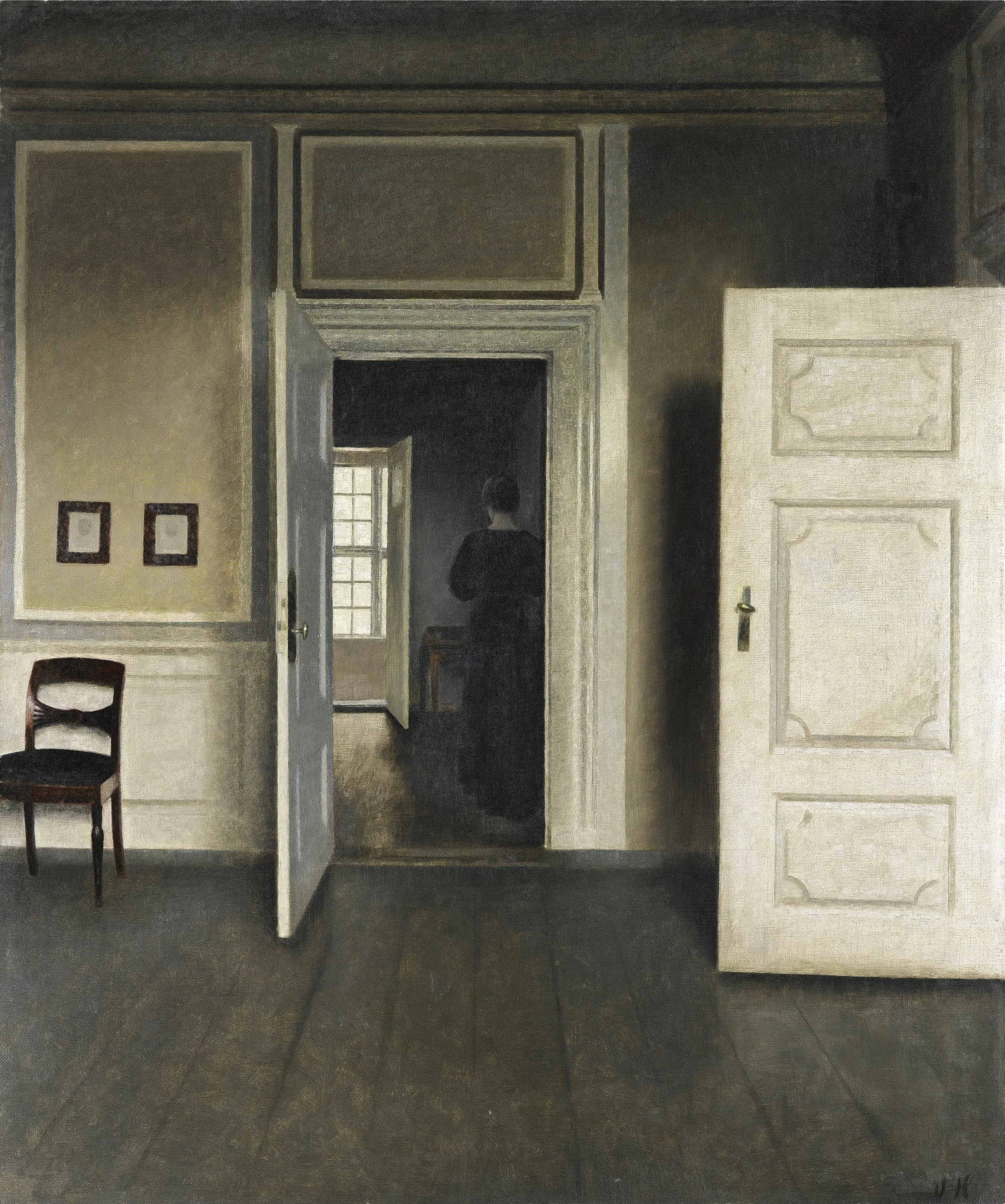
Interior. Strandgade 30 by Vilhelm Hammershøi (1901).
Before You Read: What Circling and Transformational Connection Look Like in Practice
A circling and transformational connection session is simple in structure, even if the experience itself can feel unfamiliar at first. A small group sits together, guided by a trained facilitator. There is no agenda to solve problems, give advice, work toward any kind of insight, or resolve anything. People speak only when something is happening for them in the moment, and silence is treated as a valid part of the process rather than something to fill.
Nothing is required. You are always free to just be and observe in silence or speak if you feel moved to do so. There is no expectation to share personal history or explain yourself. The pace is intentionally slow, allowing people to notice sensations, emotions, and relational shifts as they arise rather than rushing to interpret them. For many first-time participants, the experience feels less like a discussion and more like learning to listen (both inwardly and with others) without needing to perform or arrive anywhere.
Circling and Transformational Connection: Learning to Pay Attention Together
These practices are live, relational practices in which a small group of people, usually four to twelve, comes together to explore what is happening right now, both within themselves and between one another. The focus is not on recounting past events or working through personal narratives, but on attending to what is arising in immediate experience as it unfolds. Participants speak from sensations in the body, emotional tones, shifts in attention, and the subtle movements of connection that arise in the moment. What matters is not having something interesting to say, but noticing what is already present and giving it language.
For this reason, it is often described as a form of relational meditation or contemplative dialogue. The emphasis is on contact rather than analysis. Over time, this contact tends to bring a kind of clarity that does not come from thinking harder or reaching better conclusions, but from learning to stay with your present experience long enough for it to show itself.
The practice has spread internationally. It tends to attract people who are reflective and articulate, yet find that insight alone has not resolved certain recurring patterns in their lives.
One of the most common reasons people are drawn to the practice is a quiet sense of inner ambiguity. Many people can explain their feelings in detail, yet still feel uncertain about what they actually want or who they are becoming. Life can begin to feel guided by habits, assumptions, or inherited stories rather than by something directly felt. The practice slows the pace enough for experience to come into focus. When attention is allowed to rest on what is happening now, layers of feeling and meaning often appear that had been operating just outside awareness.
Another area where the practice tends to have an impact is in relationships. Everyone develops habitual ways of relating—how they seek approval, avoid tension, fill silence, or pull back when things feel uncertain. These patterns usually feel normal from the inside, even when they quietly shape every interaction. In circling, relational dynamics are often named by participants as they happen. People reflect how they experience one another in real time, often with surprising simplicity. This kind of feedback can be disarming. It bypasses speculation and gives people a chance to see themselves in action rather than in retrospect. People start to see how they are actually showing up in the world through the lens of other people's perspectives, but without the usual critical judgment.
Emotional life also often comes into clearer view. Some participants arrive feeling disconnected from their emotions, while others feel overwhelmed by them. The practice offers a different way of relating to feeling. Emotions are approached as experiences that can be sensed and described without needing to explain, justify, or resolve them. Over time, people often find that emotions move more freely when they are met with simple attention rather than resistance. Often people notice over time there is more room to feel without being overtaken.
Many people also start to notice how fragmented their sense of self has become across different relationship contexts such as with family, friends, partners, and social situations. It is common that we adapt unconsciously to different situations, becoming more guarded in some settings and more performative in others. The practice creates a space where there is little, if any, reward for managing impressions. Silence is allowed. Uncertainty is welcome. When awareness forms over how you are showing up, often the feeling of a need or the pressure to perform drops and a more consistent way of being has a chance to emerge, one that feels recognizable across all relationships and social situations.
What makes the practice work is not instruction, but mechanism. Attention is continually drawn away from explanation and toward experience. Participants are invited to notice sensations, impulses, emotional shifts, and relational movements as they arise. At the same time, awareness is shared. Others describe how they are experiencing the interaction in the moment, offering mirrors that are impossible to access on one’s own. This combination of inner noticing and relational reflection tends to reveal patterns with unusual clarity.
There is also a bodily dimension to this learning. The practice moves at a pace that allows the nervous system to settle. As people become more familiar with staying present in uncertainty or mild discomfort, reactivity often softens. A sense of safety develops, not because difficult experiences disappear, but because there is growing confidence in the ability to remain with them.
With continued practice, the effects of the practice often extend beyond the circle itself. People begin to notice the same cues in everyday life that they have learned to track in the practice: tension rising in a conversation, the urge to explain too much, the moment attention drifts away from connection. These perceptions tend to arise on their own, without effort. Alongside this, many people report a quieter form of self-trust. Decisions feel less tangled. There is less internal debate about what to say or do, and more reliance on what feels present and real.
Over time, relational feedback becomes internalized. People can sense when they are withdrawing, pushing, or filling space unnecessarily. Communication often becomes simpler. Relationships feel less effortful, not because conflict disappears, but because it is met earlier and more directly. Emotional recovery tends to be faster. There is a growing sense of continuity between inner experience and outward expression.
For someone attending an event for the first time, the setting is usually straightforward. Participants sit together, guided by a facilitator who establishes clear agreements to ensure everyone has the space to open up, if they choose. There is no requirement to speak, and quietly observing is always an available option. The rhythm may feel slow at first, with pauses that leave room for noticing rather than filling space. People tend to speak from what they are experiencing in the moment rather than from prepared thoughts. Some participants feel an immediate sense of recognition. Others feel uncertain or slightly unsettled. Both responses are common, especially early on.
The practice does not promise resolutions or answers. It offers a way of paying attention together that gradually changes how experience is met. One of the quieter signs that it is having an effect is a shift in what feels important. Managing impressions loses some of its urgency. Being in contact with what is actually happening takes precedence. From there, life does not suddenly become simpler, but it often becomes more direct. Conversations unfold differently. Relationships adjust. Inner tension loosens in small, cumulative ways that continue to reveal themselves long after the practice has ended.
I facilitate monthly events in Pensacola, FL. If you’re local or visiting, join us. You can find more info out here. If you are not in the area, I will start hosting these online soon, so stay tuned.
If you’re interested in my work as a philosophical guide for personal or business needs, or if you have a question about circling and transformational connection, feel free to email me. I look forward to speaking with you.
