Is Philosophy a 4-Letter Word?
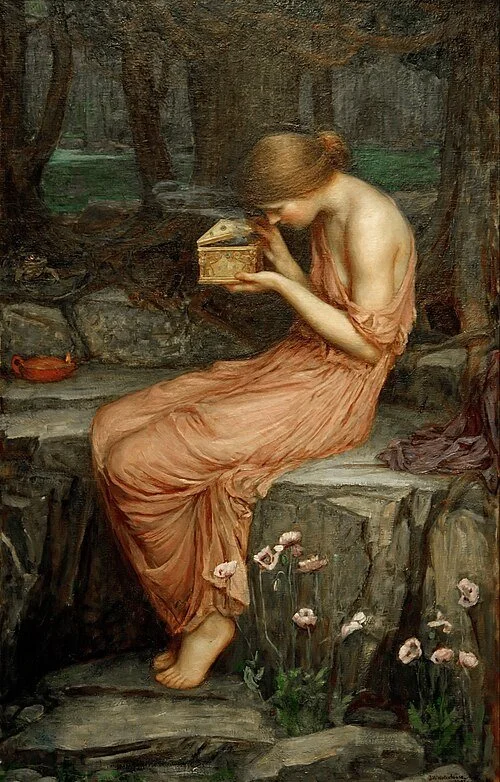
Psyche Opening the Golden Box — John William Waterhouse
Many people hear the word "philosophy" and their eyes glaze over. And honestly? That makes sense. If what comes to mind is a stuffy academic discipline made up of dense arguments, obscure language, the kind of sentences that require a dictionary just to reach the end, then of course the eyes glaze over. Who wants that?
That version of philosophy, the one that puts most of us to sleep, isn't really what philosophy was meant to be. And it isn't what philosophical guidance is.
To begin with, what does the word philosophy actually mean? Translated from the original Greek, philosophia simply means the love of wisdom. Not the love of how smart I can sound using big words. Not the love of constructing elaborate maps of reality that no ordinary person could navigate. The love of wisdom. And what is wisdom, if not something lived? Something practiced? Something that shapes the way you actually move through your days and your relationships and your choices?
To love wisdom, in the original sense, is to love life. To live it. To explore it with genuine wonder, in the hope of living as fully and meaningfully as possible. You don't need complicated arguments for that. You don't need specialized language or a vast library or the ability to cite obscure texts. In fact — and this is the part that might surprise you — those very things we call "philosophy" today could be one of the larger impediments to living a wise life. They can place assumptions and demands upon reality that are unrealistic, unattainable, or even, if we're being honest, a little nonsensical. The largest danger this academic form of philosophy poses is that by really committing to a philosopher's map of reality, you may unwittingly lock yourself into their thoughts, their worldview. Not yours.
Somewhere along the way, something got lost. Philosophy got distorted, until it became the dry, mostly irrelevant academic discipline many of us encountered in school and promptly forgot or avoided altogether.
What was philosophy, before it became that?
It was a way of life. Not a set of positions to defend or a body of knowledge to accumulate — a practice. Ancient philosophers didn't just think about how to live well. They trained themselves to do it. They gathered in communities and schools to practice together: exercises of attention, of memory, of contemplation, of questioning. The Stoics had their morning reflections and evening reviews. The Epicureans had their garden. Plato engaged in dialogues. Philosophy, for all of them, was something you did with your whole life, not just your intellect. It was about how you show up in your life at home, at work, with friends, in your community, and with loved ones. It was about how you show up for your self.
And at the center of many of these traditions was the dialogue. The live, present, unscripted exchange between two people genuinely trying to understand something together. This is what some 2,500 years ago Socrates did in the public marketplace with all manner of people in Athens: not writing treatises, not giving lectures, but stopping people and asking them questions. Simple questions, usually. What is courage? What is justice? Do you actually know what you think you know? And something in that looking closely, together, was the practice itself.
Two people, talking. Wondering together. Not one lecturing the other from a position of superior knowledge, but both genuinely engaged in exploration, following the thread of a question wherever it leads.
Oddly enough, this practice is almost entirely absent from philosophy classrooms today. It got lost along the way, along with so much else. But it's what we do in philosophical guidance. Dialogues. Two people talking.
Is that it? Can it really be that simple?
Perhaps it can. To love wisdom, to want to live a full and meaningful life, to genuinely examine the life you're living — none of this requires specialized knowledge or a particular background. It requires openness. Curiosity. The capacity to have a normal conversation about your own experience and be willing to actually look at what shows up.
Two human beings, plus wonder, exploring life and their experience of reality together. That's philosophical guidance at its most basic.
So what does a philosophical guide actually do in that dialogue?
They're not there to tell you what reality is. They're not there to hand you a philosophy, or a framework, or a set of beliefs that you're expected to adopt. They're not there to give advice, to teach, or to judge. A philosophical guide is someone who has committed their own life to this practice — who engages in these dialogues and reflections and explorations in their own living, not just in theory — and who has trained in the particular art of guiding a conversation so that you can do the work of examining your own life.
The guide is an assistant. A companion in inquiry. Someone who holds space for you to explore your own thinking, your own values, your own sense of what this life is about, on your own terms and in your own way. The point isn't for you to arrive at their conclusions. The point is for you to come into clearer contact with your own. To discover the treasures you have for yourself.
What does that actually look like? Imagine you sit down — in a room, on a video call, wherever the conversation happens — and you begin to speak about something that's been on your mind. Maybe it's a crossroads you find yourself at. A feeling that the work you're doing has stopped meaning what it once did. A relationship that's asking something of you that you haven't quite been able to name. You talk, and the guide listens. Not passively, not waiting to respond with an answer, but actively — following the shape of what you're saying, noticing where there might be more, where a word you used carries more weight than you perhaps realized, where a question might open something rather than close it.
And then they ask. Not to challenge you or catch you out, but out of genuine curiosity about what's actually there. What do you mean by that? What does that feel like when you sit with it? Is that something you chose, or something you inherited? The questions aren't a technique, they aren't driven at a prescribed outcome. They're an invitation to look more carefully at your own experience, in real time, with someone genuinely present beside you.
This is different from therapy, which tends to focus on psychological patterns, symptoms, and healing. It's different from coaching, which tends to orient toward goals, performance, and future outcomes. Philosophical guidance is interested in something more fundamental: how you understand your own life, what you actually believe about it, and whether the values you're living from are ones you'd still choose once you examine them for yourself. It asks not just "how do I get where I want to go?" but "do I know where I want to go, and why, and whether that destination is truly mine?"
And here's what that kind of dialogue can make available. A question you've been carrying for years — something about whether you're on the right path, whether the life you're living actually reflects what matters to you, whether the values guiding your choices are truly yours or ones you inherited without quite noticing — that kind of question can begin to breathe in a dialogue. It can unfold. Not because someone handed you an answer, but because you had the space and the company to actually look.
This matters more than it might initially seem.
Consider what it costs to keep moving through life without that examination. Not in a dramatic sense, but in the quiet, ordinary sense: the low-grade sense that something is slightly off, that the path you're on was somehow built by other people's ideas of who you should be and what success should look like. Many people carry this. It doesn't always announce itself loudly. It tends to show up as a kind of restlessness. A question that won't quite go away. A feeling that you're going through the motions of a life rather than actually living one.
What gets lost, when we don't examine that feeling, is the possibility of actually choosing. Of finding out what you genuinely value and orienting your life around it. This isn't a luxury. It's, in some sense, the whole project.
Philosophical guidance doesn't fix this from the outside. It can't. But it can create the conditions in which you begin to see more clearly what's already there, waiting to be understood.
That said, philosophical guidance isn't for everyone, and it's worth being honest about that.
If you have no particular interest in understanding more about yourself or your life, it may not be the right fit. If you love your current ideas so much that you'd rather not risk having them change or develop — and there's nothing wrong with that, it's simply good to know it about yourself — then this probably isn't for you.
But if you are a person who wonders about life. Who wonders about meaning. Who wonders about yourself and suspects there's more available than you currently have access to. And if you're willing to let your self develop and shift in the process of genuine exploration... then a guided dialogue with a philosophical counselor might be exactly what you've been looking for without quite knowing it.
So if the image in your head involves a tweed jacket, a pipe, a beard, and a vast library of leather-bound books — you can breathe a sigh of relief. It's just two humans meeting, heart to heart, to see what your life is actually about.
If you're ready to wonder, you're welcome to begin. A free discovery call is a good place to start.
Useful Frames offers philosophical guidance through one-on-one dialogue. If this resonates, you're welcome to reach out.
Alistair McKenzie is an APPA-certified Philosophical Counselor, Level Two Circling Facilitator (Circling Europe), Level Two Transformational Connection Facilitator, Dialectic into Dialogos Facilitator, and Authentic Revolution trained facilitator with an extensive background as a lawyer and entrepreneur located in Pensacola, FL. Serving clients in-person and worldwide online.
Follow us: