
When the Map Becomes the Territory
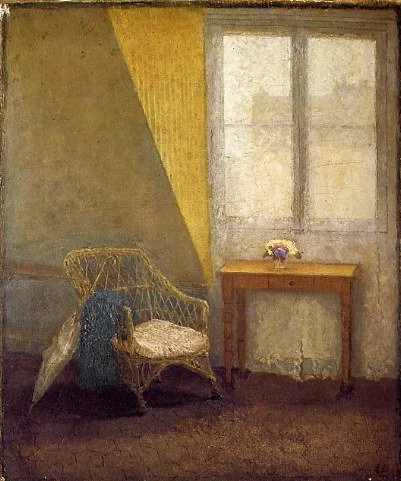
A Corner of the Artist's Room, Paris, Gwen John.
The Familiar Pattern of Seeking
You arrive at a spiritual teaching or contemplative practice with questions. Real questions born from actual confusion or longing. Maybe you've felt that your life, successful as it appears, doesn't quite feel like yours. Maybe you've sensed something deeper wanting to emerge but can't name what it is.
So you read. You practice. Go to workshops. Sit with teachers. And somewhere along the way, something genuine happens. A moment where the usual boundaries soften. Where you see yourself and the world differently. Where clarity arrives unbidden.
What do you do with that moment? Most of us reach for language to hold it. We find frameworks that seem to capture what we experienced. We learn new vocabulary: presence, awakening, consciousness, true nature. These words feel more accurate than our old ways of speaking. They feel truer. But notice what happens next. Those words, those frameworks, those new beliefs about what you experienced start to solidify. You begin living inside them like you lived inside your old beliefs. The content changed, but did the pattern?
You went seeking to find freedom from the life that felt constructed by others' expectations. Yet here you are, potentially living inside a new construction. This one feels more refined, more conscious, more spiritual. But is it yours? Or have you simply traded one set of borrowed beliefs for another?
How does this feel in your actual life? Perhaps like you're performing a more spiritual version of yourself. Perhaps like there's a gap between your insights and how you actually move through your days. Perhaps like you're hiding, even from yourself, behind ideas about awakening rather than living from what you've actually seen.
I've Walked This Ground Too
I notice this pattern because I've lived it. For fourteen years I practiced law. I learned to build arguments, to defend positions, to make ideas sound convincing. When I turned toward philosophical and spiritual training, I brought those same skills with me. I got very good at constructing sophisticated frameworks about awakening, about presence, about the nature of reality.
What I didn't see for a long time was how those frameworks were blocking me from something simpler and more direct.
Through my training in philosophical counseling and years of practicing dialogue-based inquiry, as well as participating in and facilitating relational practices, I've sat with many people at this threshold. What I've learned is this: even those who've had profound experiences of awakening, moments that utterly transcended ordinary consciousness, almost always continue clinging to beliefs they've placed beyond question. These protected ideas severely limit how deeply that awakening can actually express itself in lived experience. A shift may have happened, but integration into your life may still be waiting for you.
I'm not standing outside this pattern either, looking down with some kind of perfected clarity. I still catch myself reaching for certainty when the ground feels uncertain. But I've learned to recognize the reach. To pause. To ask and look to see what I'm protecting.
This isn't a problem to fix. It's just a pattern to see clearly.
Three Ways to Begin Seeing What You're Protecting
1. Notice the Rooms You Don't Enter
Think of your understanding like a house you inhabit. There are rooms you move through easily. Ideas you examine without fear. Beliefs you can hold up to the light and turn around to see from different angles.
Then there are the rooms with closed doors. Beliefs you don't examine. Questions you don't ask because asking them might require rebuilding something you've worked years to construct.
What lives behind those doors? What belief about yourself, about your path, about the nature of awakening or consciousness have you placed beyond question? Not beliefs you disagree with, but beliefs you require. The ones where even imagining they might not be accurate creates a small flutter of resistance in your chest.
You might try sitting with that question. Not to judge what emerges, but to see it clearly. Like picking up a stone and really looking at its weight and texture for the first time. What becomes visible when you bring genuine curiosity to what you've been protecting?
2. Taste the Tea, Not the Menu
You're making tea. You pour hot water over the leaves. Steam rises. The color begins to change. You lift the cup and taste the warmth, the bitterness, the subtle sweetness underneath. That's direct experience.
Then you might think, "This is good tea" or "This reminds me of the tea ceremony I attended" or "This is helping me be more present." Those thoughts aren't the experience. They're commentary about the experience. The menu describing the meal, not the meal itself.
The same thing happens with spiritual experiences. Something opens. You have a direct, immediate experience of clarity or connection or presence. Then the storytelling begins. "I had an awakening. I experienced my true nature. This confirms what the teaching says."
These stories aren't wrong. But they're not the experience itself. And when you start living in the story instead of staying present to direct experience as it unfolds, that's when the map replaces the territory.
What if you recalled a moment of genuine spiritual clarity and described it without using any spiritual language at all? What actually happened? What did you notice in your body? What shifted in your perception? The raw experience before the interpretation often reveals something we've been missing.
3. Look at the Gap Between Knowing and Living
Here's where things get honest. The real question isn't what you've realized in meditation, at a workshop, or from a book. It isn't what insights you've had or what you understand about consciousness or presence. The question is: how do you actually move through the world?
Think of learning to bake bread. You can read every book about the chemistry of yeast, about gluten structure, about fermentation. You can talk eloquently about the process. But until you get flour on your hands and feel how the dough responds to your touch, until you learn through your body when it needs more water or when it's been kneaded enough, you're not actually baking bread. You're thinking about baking bread.
Philosophical guidance (a form of philosophical counseling) works in this space between insight and expression. Not through more concepts or more understanding, but through dialogue that helps you see where you're still performing your spiritual insights rather than living from them.
What if you looked at your week? Where did your actions contradict what you genuinely know? Not to shame yourself. Just to see clearly. These gaps are where unexamined beliefs are still operating beneath awareness, shaping your behavior in ways you haven't noticed.
What Deepens If Nothing Changes
If you have had some insights or openings but continue protecting certain beliefs from genuine inquiry, pain usually arises from the cognitive dissonance. Over time, it intensifies as you try to hold on to a new identity.
The gap between who you know yourself to be in moments of clarity and how you actually live widens. What started as a small misalignment becomes a chasm you have to work harder and harder to bridge.
The exhausting effort of maintaining a spiritual identity becomes more demanding. You'll find yourself defending your insights more vigorously, proving your understanding more frequently, working harder to maintain the appearances.
Those genuine moments of seeing you've had recede further into memory. What was once alive becomes fossilized. Your insights don't just harden into beliefs. They calcify into dogma you use to judge yourself and others.
You'll keep upgrading your beliefs, trading old certainties for newer, more refined ones. Each time thinking, "This is it. This is the real truth." The pattern of grasping for certainty tightens its grip. The cage gets more sophisticated, but it's still a cage.
And your daily life? The feeling of performing rather than being, of managing an image rather than showing up honestly, of hiding even from yourself, all of this intensifies. The very thing you turned to seeking to escape, living inside someone else's construction of what your life should be, you recreate more completely, this time with spiritual materials that feel harder to question.
That original sense that brought you to this path, that your life doesn't quite feel like yours, doesn't fade. It sharpens. Because now you're not just living someone else's expectations. You're living inside your own spiritual concepts about what an awakened life should look like, and the gap between concept and reality grows more painful.
What Opens When You Stop Hiding
Imagine waking up tomorrow and moving through your day without needing your experience to match what you think it should be. No performance. No spiritual identity to maintain. No beliefs to defend or insights to prove. Just here. Just present. Just aware and responsive to what's actually in front of you.
Your relationships become simpler. More honest. You're not managing them according to how a conscious person should relate. You're just relating, moment to moment, to what's actually present. Conflict doesn't threaten your spiritual self-image, so you can meet it with curiosity instead of defensiveness.
Your decisions feel clearer. Not because you've figured everything out, but because you're responding to reality as it is rather than as your concepts say it should be. When a choice needs to be made, you're drawing from lived clarity rather than ideas about clarity.
The gap between understanding and behavior closes. Not because you've perfected yourself but because you've stopped hiding behind ideas about what perfection looks like. Your insights begin naturally informing how you move through the world because you're no longer using them as armor or identity.
You still have beliefs. You still use frameworks when they're helpful. But you hold them lightly. Like tools you pick up when needed and set down when you're done. You're not living inside them. You're living on the ground of actual experience, and the tools are there when you need them.
What you've been seeking isn't something to attain or maintain. It's what remains when you stop reaching for the security of knowing. It's what's here when you're willing to stand in genuine not-knowing and meet what's actually present.
Standing at the Threshold
This work of questioning what you've placed beyond question is delicate. It asks something of you that's genuinely challenging.
The beliefs you're protecting are usually protecting something. Fear, maybe. Identity. The need to feel secure in a world that's fundamentally uncertain. Doing this inquiry alone is possible, but it's difficult. We all have blind spots. Places we can't see because we're standing in them.
Philosophical guidance offers something different than therapy or coaching. This isn't about fixing what's broken or achieving goals. It's about seeing clearly. About bringing genuine curiosity to the places you've been afraid to look.
Through guided dialogue, we explore together what you haven't been able to see alone. Not because I have answers you don't. But because in genuine dialogue, something becomes visible that neither of us could see separately.
If what you've read here touches something true in your experience, if you sense there are questions you've been afraid to ask, beliefs you've been protecting, ways you're still hiding behind spiritual certainty, I invite you to explore whether this work might serve you.
We would begin with a discovery call. This is a moment to stand at the threshold of your own becoming and see whether philosophical guidance is the next step calling you forward. Not to convince you. Not to give you new beliefs. Simply to see, together, what's actually here when we bring genuine attention to it.
You can schedule that conversation below. No commitment beyond curiosity. Just an hour to explore what becomes visible when you stop defending what you think you know and open to what you haven't yet seen.
Alistair McKenzie is an APPA-certified Philosophical Counselor, level two circling facilitator (Circling Europe), level two Transformational Connection Facilitator, Dialectic into Dialogos facilitator, and trained professional facilitator with an extensive background as a lawyer and entrepreneur located in Pensacola, FL, and serving clients worldwide.
